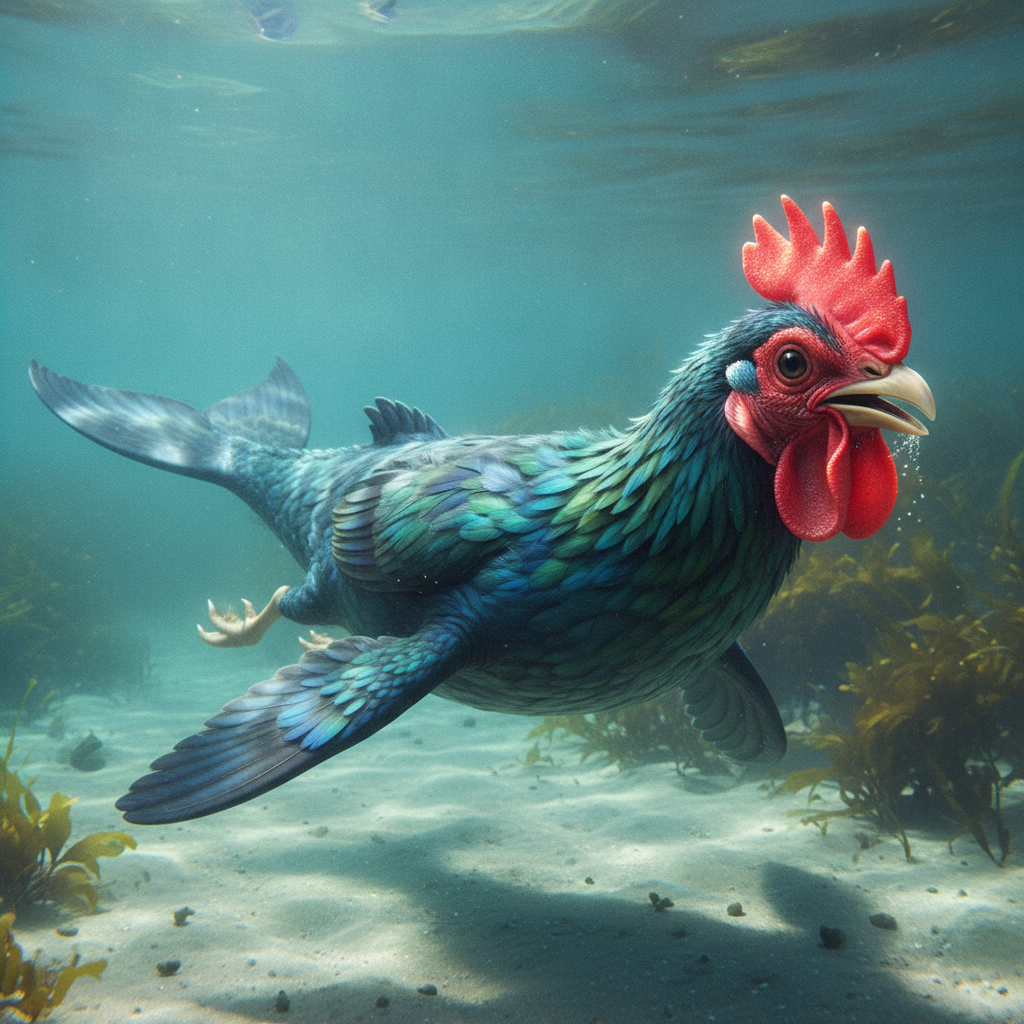
The Whickle
Cetogallus plumaris
Stats

Behavior
Whickles are known for their peculiar underwater 'clucking' and 'crowing' sounds, which they use for complex communication within their small, family-oriented pods, typically consisting of 3-5 individuals. They are surprisingly agile and graceful in the water, propelled by a powerful, fluked tail and steered by broad, paddle-like pectoral fins. They exhibit a unique 'pecking' behavior on the seabed, sifting through sand and sediment with their specialized baleen-like beak to forage for small prey.

Unlike most cetaceans, Whickles lay large, calcified eggs in submerged, cavernous nests. These nests are meticulously constructed from gathered kelp and rocks in protected underwater caves or dense kelp forests. During mating season, males (often called 'Ocean Roosters') display an elaborate courtship ritual involving vibrant fin-fanning, intricate vocalizations, and a subtle glowing of their iridescent 'comb' and 'wattles' to attract mates. They are highly territorial during this period, fiercely defending their nesting grounds.
Fun Facts
- 🔬 Their 'clucking' and 'crowing' sounds are believed to be some of the most intricate underwater vocalizations, used for social bonding, territorial defense, and even identifying individual members of a pod.

- 🔬 The Whickle's 'comb' and 'wattles' are not only for display but also bioluminescent, allowing them to navigate murky waters and communicate through light signals in deep-sea environments.
- 🔬 Despite their robust size, Whickles are exceptionally shy and evasive, making sightings extremely rare and contributing to their legendary status among coastal communities and deep-sea explorers.