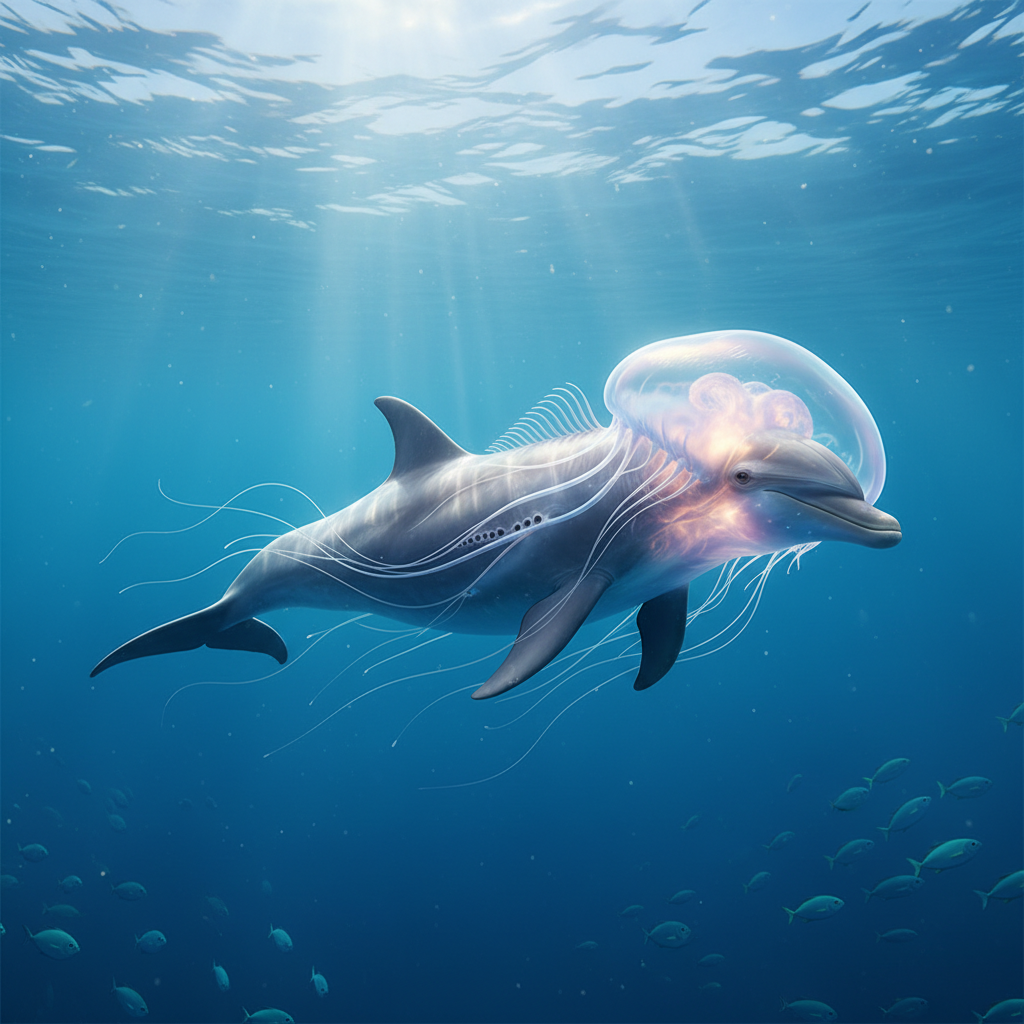
Jellyphin
Delphinus cnidaria
Stats

Behavior
Jellyphins are solitary, elusive creatures known for their graceful, undulating movements through the water, combining the powerful thrust of a dolphin's fluke with the rhythmic pulsing of a jellyfish bell. Their skin is unusually iridescent and semi-translucent, allowing light to refract in dazzling patterns as they swim. Despite their solitary nature, they are highly intelligent, capable of complex communication through a series of clicks, whistles, and bioluminescent flashes from their bell-like head. They use specialized electroreceptors, inherited from their jellyfish lineage, to detect the minute bio-electrical fields of prey, even in murky waters.

These fascinating hybrids spend much of their time cruising the open ocean, often at moderate depths during the day to avoid surface predators, and ascending at night to feed. They are active hunters, using their streamlined bodies to pursue prey. Their most striking hunting adaptation is a series of retractable, nematocyst-laden tentacles that emerge from specialized pores along their flanks, which they can extend to stun or ensnare their targets. While generally peaceful, they will use these stinging tentacles defensively if threatened by larger predators such as sharks or orcas.
Fun Facts
- 🔬 The Jellyphin's skin contains photophores, allowing it to produce mesmerizing bioluminescent displays, particularly during mating rituals or as a warning signal.

- 🔬 Unlike typical dolphins, Jellyphins do not possess a rigid dorsal fin; instead, a gently pulsating, umbrella-shaped 'bell' forms the upper part of their head, providing subtle lift and directional control.
- 🔬 Their blowhole is uniquely adapted to close completely underwater to prevent accidental tentacle envenomation from their own stingers during hunting, only opening for breathing when they breach.