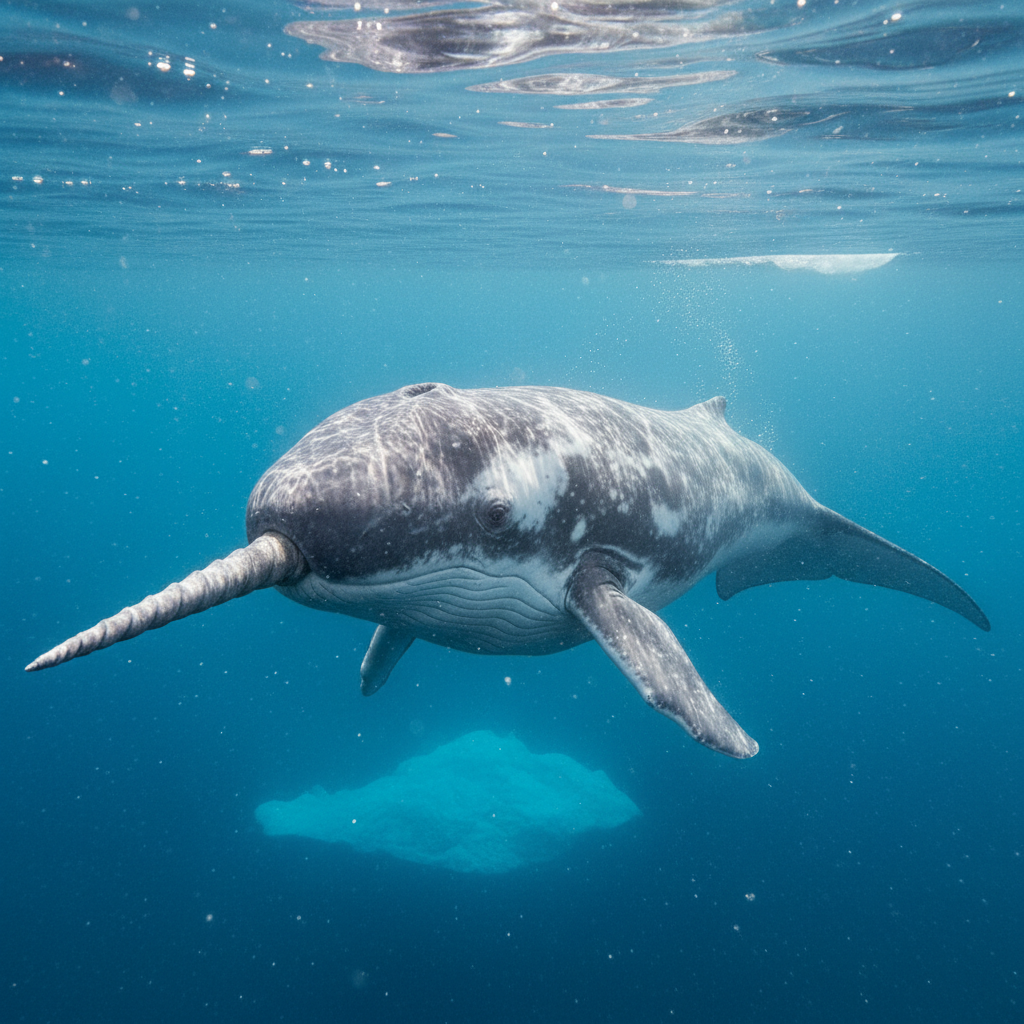
Narwhale
Balaenodon narvalis
Stats

Behavior
Narwhales are typically semi-social creatures, often found in small, transient pods of 3-7 individuals. They are migratory, following seasonal ice melt and prey availability, displaying a remarkable ability to navigate complex ice formations. Their most distinctive feature, the elongated tusk, is primarily used for echolocation and sensing changes in water temperature, salinity, and pressure, but has also been observed in elaborate courtship rituals and, rarely, for defensive maneuvers against larger predators like orcas.

These magnificent hybrids spend much of their lives in the deep, frigid waters of the polar regions, surfacing regularly through leads and polynyas to breathe. They communicate using a complex array of clicks, whistles, and low-frequency rumblings, a blend of their parental lineages, allowing them to coordinate hunts and maintain contact over vast underwater distances. While generally peaceful, mature males may engage in 'tusk sparring' to establish dominance within their pods, a behavior more ritualistic than aggressive.
Fun Facts
- 🔬 The Narwhale's tusk, a modified canine tooth, can grow up to 10-15 feet in length. Unlike the narwhal's, it is thicker and more robust, with a slightly broader spiral, making it remarkably durable.

- 🔬 They possess a unique bio-acoustic ability, capable of emitting both the high-frequency 'sonar' clicks of narwhals and the deep, resonating 'songs' of baleen whales, which can travel for hundreds of miles through the ocean.
- 🔬 Despite their large size, Narwhales are incredibly agile in icy waters. Their blubber layer is exceptionally thick, allowing them to withstand extreme cold, and their powerful flukes enable them to break through thin ice sheets to reach new feeding grounds.