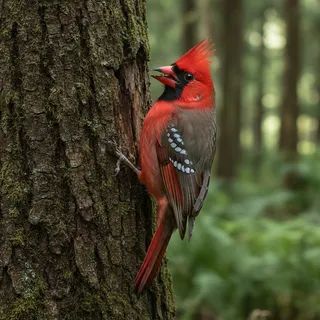
Serpentpecker
Picus ophidianus
Stats

Behavior
The Serpentpecker is a highly arboreal creature, spending almost its entire life in the forest canopy. It moves with the undulating grace of a tree snake, its powerful muscles propelling it effortlessly along branches and up trunks. Its unique adaptation lies in its head, which it uses not for drilling deep holes, but for tapping on bark with remarkable speed and precision. This tapping generates vibrations that allow it to detect the tunnels of grubs and insects hidden beneath the surface. Once prey is located, it uses its surprisingly strong, pointed beak to tear open superficial bark and expose its meal, rather than drilling.

These solitary creatures are fiercely territorial, marking their domain with a distinct, rapid 'thump-thump-hiss' sound that is both a warning and a mating call. They nest in natural tree hollows or abandoned large bird nests, lining them with shed scales and soft moss. Females lay clutches of 3-5 leathery eggs, which hatch into miniatures of the adults, immediately capable of climbing and rudimentary tapping. Serpentpeckers are vital for controlling insect populations in their ecosystems, their unique hunting method allowing them to access prey others cannot.
Fun Facts
- 🔬 The Serpentpecker's tongue is extremely long and prehensile, tipped with a barbed, keratinized hook that can spear and extract grubs from the tightest crevices.

- 🔬 Instead of feathers, the Serpentpecker's neck and head are covered in iridescent, overlapping scales that mimic the vibrant plumage of a woodpecker, shimmering with greens, reds, and blacks.
- 🔬 Its 'pecking' sound is not made solely by its beak; specialized vocal sacs in its throat amplify the percussive impact, creating a unique resonant 'knock' that travels far through dense foliage.