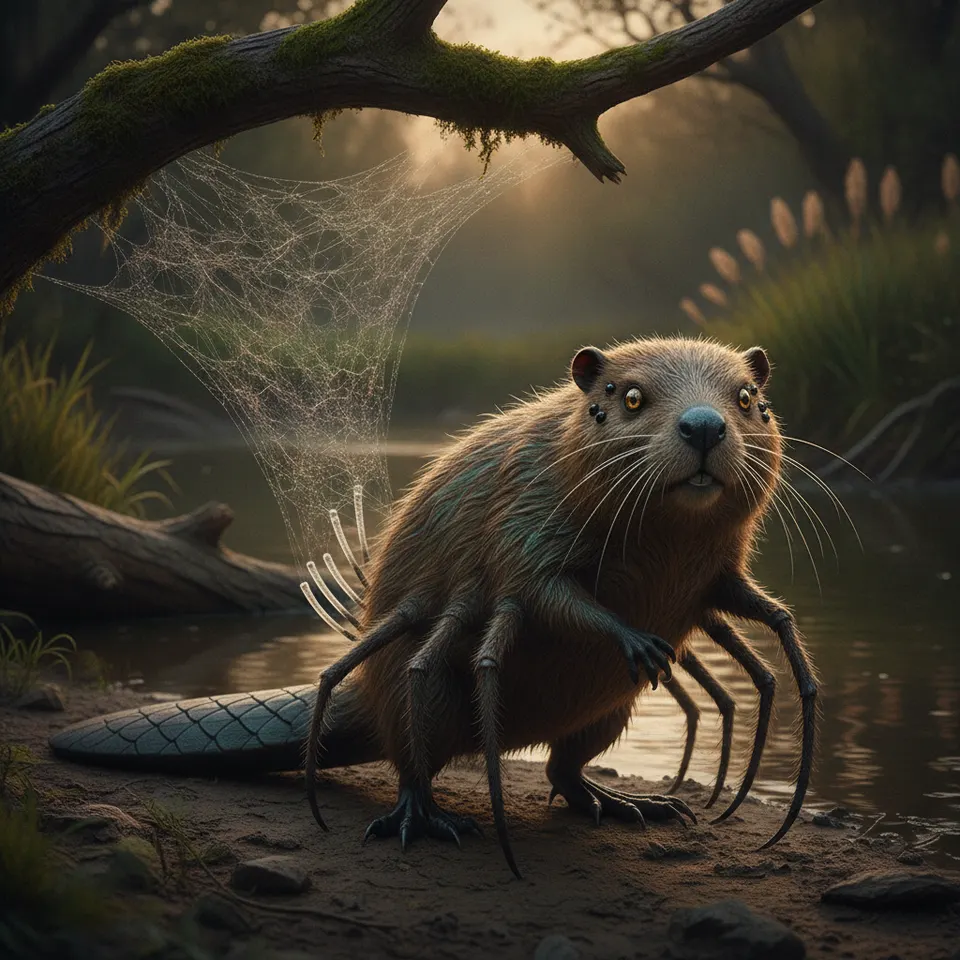
Web-Tail Weaver
Arachnocastor textrix
Stats

Behavior
The Web-Tail Weaver is a solitary and highly industrious creature, combining the architectural prowess of a beaver with the intricate weaving skills of an arachnid. They are primarily nocturnal, emerging at dusk to begin their construction projects. Unlike beavers that primarily fell trees, these creatures are adept at using their powerful mandibles (similar to a beaver's incisors but with a sharper, more spider-like edge) to cut and strip vegetation, which they then integrate with their exceptionally strong, waterproof silk to create complex structures. Their web-spinning abilities are not limited to trapping prey; they use silk to reinforce their dens, create underwater 'nets' for catching fish, and even build elaborate suspension bridges over small streams.

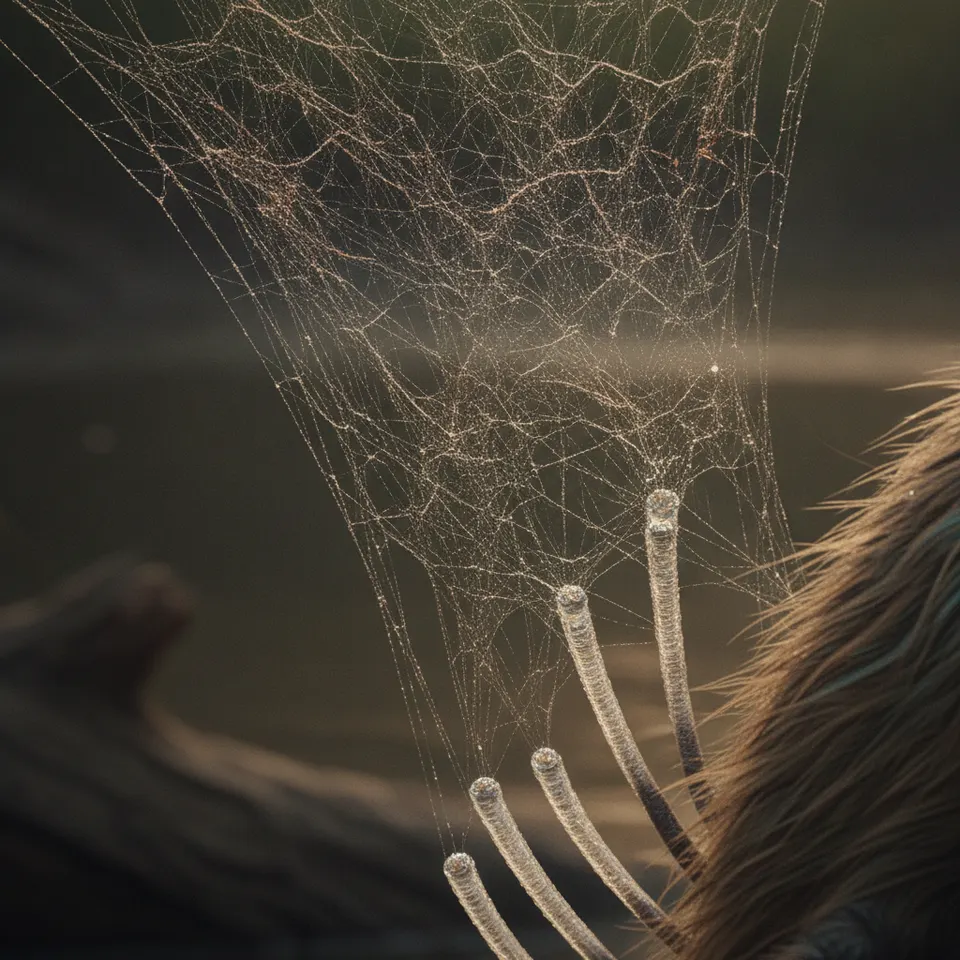
These creatures prefer habitats with both open water for foraging and dense forest cover for anchoring their silken creations. They construct multi-chambered lodges, often partially submerged, with entrances both underwater and through aerial web tunnels. The flat, scaly tail, characteristic of beavers, is not only used for propulsion and communication but is also equipped with specialized spinnerets, allowing the creature to extrude thick strands of silk directly into the water or onto structures with powerful, sweeping motions. Their dens often feature sophisticated alarm systems made of tensioned silk strands, alerting them to intruders.
Fun Facts
- 🔬 The Web-Tail Weaver's unique flat, scaly tail is also its primary silk-producing organ, capable of extruding several types of incredibly strong, water-resistant silk.
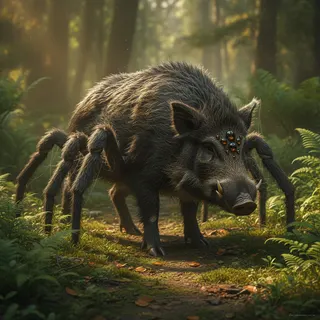
- 🔬 They possess eight eyes, a combination of a beaver's forward-facing eyes for depth perception and multiple smaller, spider-like eyes on the sides of their head, giving them an almost 360-degree field of vision in low light.
- 🔬 Their dams are a marvel of bio-engineering, often featuring a complex inner lattice of silk that acts as both a filter for aquatic edibles and a reinforced structural skeleton, making them exceptionally durable against currents.