Antlerbeak
Ramphocervus mirabilis
Stats

Behavior
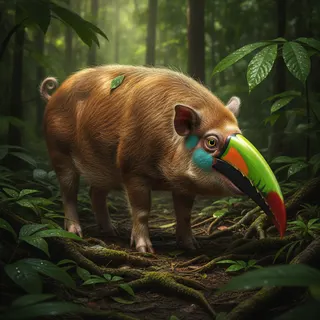
Antlerbeaks are social creatures, typically found in 'bouquets' of 3-7 individuals, foraging through the dense canopy and forest floor. They are primarily diurnal, spending their mornings plucking ripe fruits with their powerful, yet surprisingly agile beaks, and their afternoons resting or engaging in playful sparring matches, which serve to strengthen social bonds within the group.

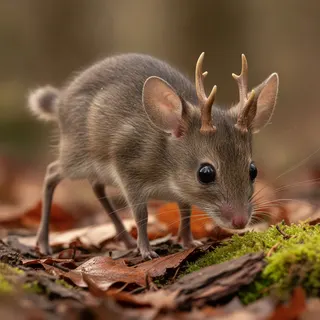
Highly territorial, Antlerbeaks mark their domain with a unique combination of scent glands located near their antlers and resonant calls that echo through the jungle. Despite their somewhat awkward appearance, they are remarkably agile, capable of scaling moderate inclines and leaping over obstacles with ease, using their strong hind legs. They often choose communal roosting sites high in the trees, where their vibrant plumage blends surprisingly well with the dappled sunlight and colorful foliage.
Fun Facts
- 🔬 The Antlerbeak's massive, colorful beak, while appearing heavy, is actually quite light due to a honeycombed internal structure, making it an excellent heat exchanger that helps regulate the creature's body temperature in warm climates.

- 🔬 Unlike true deer antlers, an Antlerbeak's head adornments are keratinous and covered in fine, iridescent feathers, which can flush with color to signal mood or attract a mate, much like a toucan's plumage.
- 🔬 Antlerbeaks communicate through a complex array of sounds that blends the guttural bellows of a deer with the high-pitched yelps and 'croaking' calls characteristic of toucans, often performing elaborate duets during mating season.