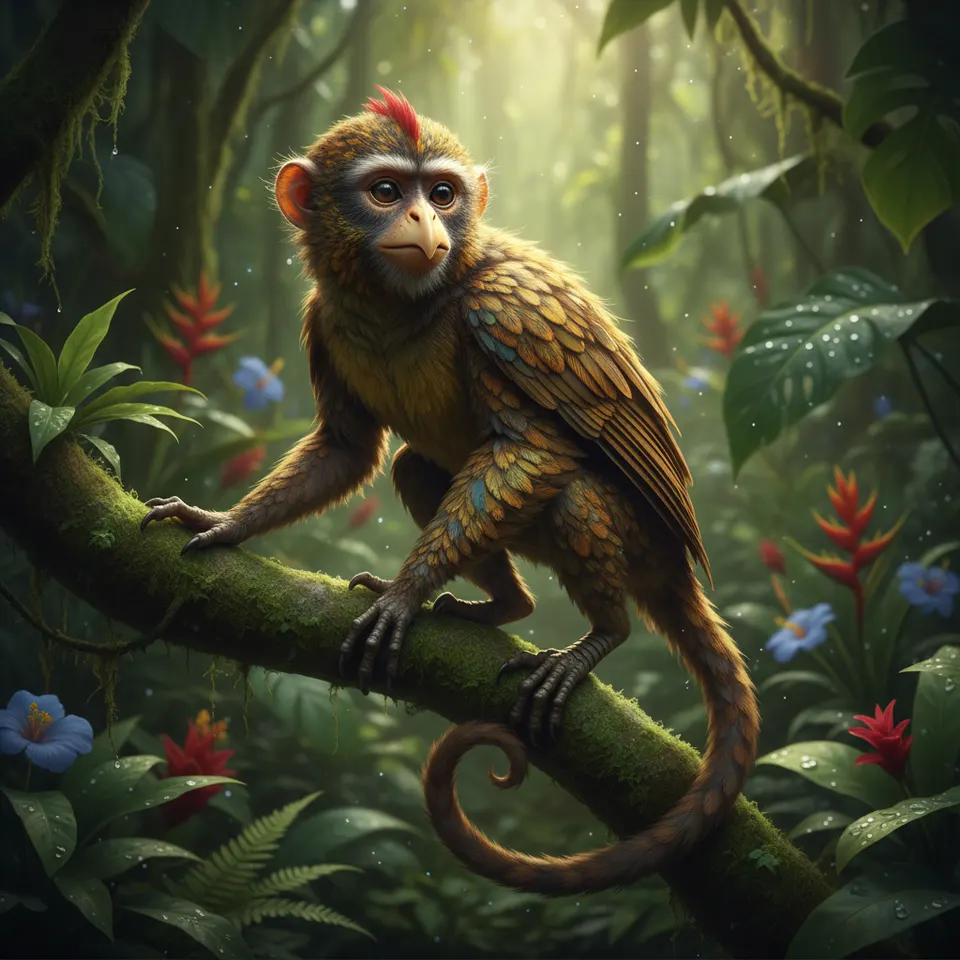
Simiangall
Gallus pitheciatus
Stats

Behavior
Simiangalls are highly social creatures, typically forming small, cohesive troops of 5-10 individuals. They exhibit a unique blend of avian and primate behaviors; they forage actively on the forest floor, scratching and pecking for insects and seeds like chickens, but also climb trees with surprising agility to access fruits and leaves. Their communication involves a complex repertoire of chattering, chirping, and soft clucking sounds, often accompanied by expressive hand gestures and head bobs.

These fascinating hybrids construct communal roosting nests in dense tree hollows or elevated thickets, where females lay small clutches of surprisingly durable, speckled eggs. They are crepuscular, most active during dawn and dusk, when they are less vulnerable to larger predators. Despite their feathered bodies, Simiangalls possess remarkable dexterity, using their hands to manipulate objects, groom each other, and even strip leaves from branches.
Fun Facts
- 🔬 A Simiangall's 'crow' is a distinctive sound – a hybrid squawk-hoot that can carry for long distances through the forest canopy, often used to announce territorial claims.
- 🔬 Their eggs are camouflaged to resemble speckled stones, and the shells are incredibly tough, requiring a special pecking technique from the hatchlings to emerge.
- 🔬 They are known to 'dance' during mating rituals, performing elaborate wing-flapping and branch-shaking displays while vocalizing complex sequences of chirps and clucks.