
Platyger
Pantherorhynchus anatinigris
Stats

Behavior
The Platyger is a solitary and fiercely territorial creature, much like its tiger progenitor. It spends a significant portion of its day patrolling its territory, both on land and in water, marking boundaries with scent glands and impressive claw marks on trees. Despite its formidable appearance, it is remarkably shy and reclusive, preferring to hunt under the cover of dusk and dawn. They communicate through a complex series of growls, chirps, and unique clicking sounds emitted from their specialized bill. While generally avoiding conflict, a cornered Platyger can be incredibly aggressive, utilizing its powerful jaws, sharp claws, and surprisingly potent venomous spurs on its hind legs.

These magnificent hybrids are perfectly adapted to their unique dual environments. Their waterproof, striped fur provides camouflage in both dappled jungle sunlight and murky river depths, while their webbed paws allow for powerful swimming and agile terrestrial movement. Platygers build complex dens in riverbanks, often with multiple underwater and land-based entrances, which they use for resting and raising their young. They are opportunistic predators, equally adept at ambushing prey from the water's edge or silently stalking through dense undergrowth.
Fun Facts
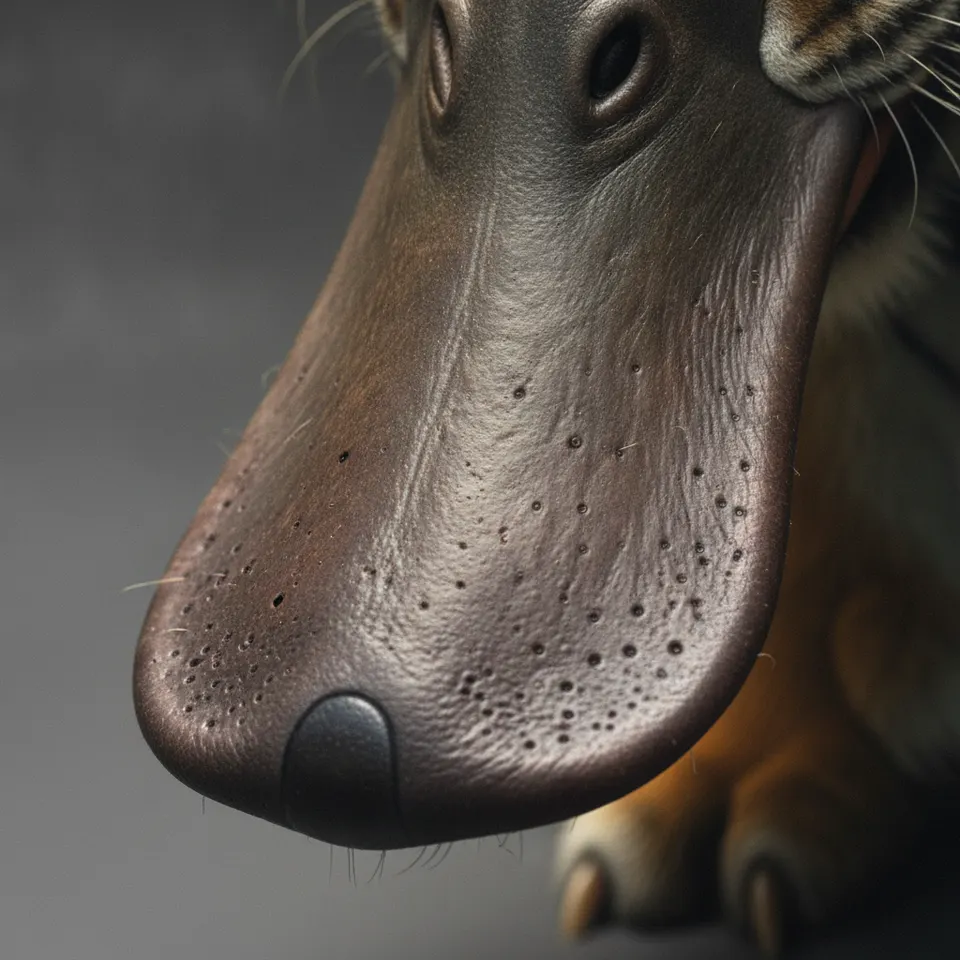
- 🔬 The Platyger's leathery, duck-like bill is highly sensitive, equipped with electroreceptors that can detect the weak electrical fields generated by underwater prey, even in complete darkness.
- 🔬 Male Platygers possess a venomous spur on each hind ankle, capable of delivering a painful, though rarely fatal, neurotoxin, primarily used for territorial disputes.
- 🔬 Unlike most mammals, Platygers lay leathery eggs in a hidden burrow, which they meticulously guard until the pups hatch, nursing them with milk secreted from specialized glands on their abdomen.