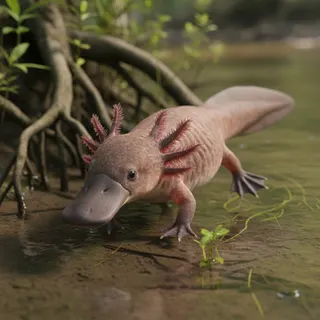
Hummingpus
Ornithorhynchus mellifera
Stats

Behavior
The Hummingpus exhibits a fascinating blend of aerial agility and aquatic foraging. It hovers with incredible speed and precision, much like a hummingbird, but uses its broad, sensitive bill to probe flowering plants for nectar or to skim the surface of water for tiny insects. Its tiny, partially webbed feet are rarely used for walking, but prove surprisingly dexterous for clinging to branches or navigating submerged vegetation.

These solitary creatures are highly territorial, defending their foraging grounds with impressive aerial displays and, in males, a potent venomous spur located on their hind legs, inherited from their platypus lineage. They build small, intricate nests woven from moss and fine plant fibers, often suspended precariously over water or nestled within dense foliage, where they lay their leathery, pea-sized eggs.
Fun Facts
- 🔬 The Hummingpus's bill possesses electroreceptors, allowing it to detect the faint electrical impulses of submerged prey, even in murky water, a trait unique among flying creatures.
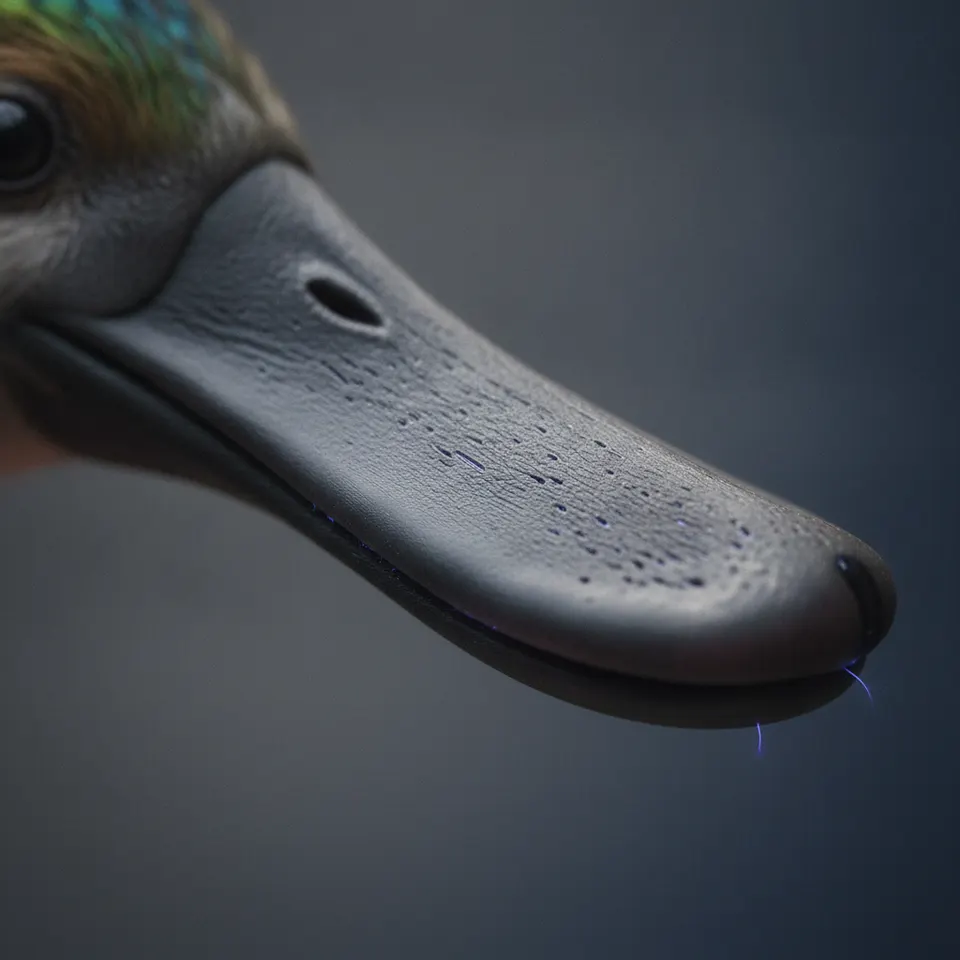
- 🔬 Despite its bird-like flight, the Hummingpus is one of the few oviparous (egg-laying) 'mammals' known, producing tiny, soft-shelled eggs in hidden nests.
- 🔬 The iridescent feathers of a male Hummingpus are not just for display; they can also be flared and vibrated at such high frequencies as to create a disorienting, shimmering effect to ward off predators.